-
The attempt to move away from X has been a clear failure. Bluesky is still irrelevant and media people in particular are realizing they’ll be out of the loop if they’re not on “the bird site” (remember when people called it that?) schwarztech.net/snippets/…
-
Thinking that difficult media is inherently superior (“deeper”) is what I like to call “the Dark Souls fallacy.” Masochistically subjecting yourself to opaque and frankly sloppy design in works like FromSoftware games and DFW novels is no different than performing Catholic penance for imagined sins.
-
One of the best arguments against getting a degree in English is that you’ll spend lots of time reading disreputable French and German theorists who, on top of being impenetrable, couldn’t have cared less about English per se.
-
The affinity that many have for gold as “real money” and their obsession with the “national debt” are legacies of Watergate. Nixon ended the convertibility of dollars into gold, making the debt meaningless; fiat money reigns supreme. But since he’s a historic villain, this action becomes suspect.
-
Something that will change your life is realizing that the German word “Spätkapitalismus,” almost universally translated “late capitalism,” is just as valid rendered “capitalism, lately”. It doesn’t imply that capitalism is ending.
-
Why can't England win another men's FIFA World Cup?
A soccer homecoming
Even Americans indifferent to soccer1 can easily become bogged down with the England national team. The common language and the erstwhile “special relationship” between the two countries means that the “can England finally win it all again?” narrative is as heavy as the smell of ash and petrichor after a wildfire and an ensuing June shower during every World Cup.
Since 2018, the speculation has been given the extra glow of “Is it coming home?”, a narcissistic reflection that shimmers with both the British2 origins of the sports and the forced nostalgia for the 1996 song “Three Lions,” written for the occasion of UEFA Euro 96, which England hosted and lost in the most England way: On penalty kicks after a 1-1 draw with Germany. Its chorus incorporated the tournament’s slogan: “Football’s coming home,” a grand pronouncement that sounds comical to American ears, which at least for me synthesize this line into an image of the anthropomorphized rugby-inspired ball of American football driving down a highway.
The 1960s were a different planet
England won its first and so far only men’s World Cup final in 1966. Here are some facts about international soccer in 1966:
- There were no yellow or red cards.
- You couldn’t make tactical substitutions.
- You could backpass the ball to the goalkeeper for him to pick it up.
- The offside rule was even stricter.
- Argentina, France, and Spain had yet to win their first World Cup finals.
Since that time, England has never gotten back even to the final, let alone won it. Smaller nations such as the Netherlands, Croatia, Poland, and Sweden have come at least as close to winning the title in the last 60 years3 as England, the birthplace of “football.”
CRT memories
I began watching England’s 1998 round of 16 match against Argentina on a CRT TV at my parents' house, and finished it on an even bigger tube TV at my grandpa’s house, next door—it was such a drawn-out match that I had to walk over to the latter for dinner, during which I got my first experience with the added 30 minutes of extra time and the penalty-kick shootout. Likewise, I saw them eliminated by Brazil in 2002 in my parents' living room, by Portugal in 2006 at my grandpa’s, by Germany in 2010 on a grainy feed in my first real apartment, and by Croatia in 2018, France in 2022, and Argentina in 2026 in my house. Even as someone who’s not an England fan, the country’s struggles with its own game have been apparently unmissable.
Soccernomicist
Shouldn’t they have won more, though? That’s the sentiment underlying the pervasive coverage that’s so disconnected from their actual success. Probably not: Simon Kuper and Stefan Szymanski’s Soccernomics, first published in 2009 as Why England Lose, has exhaustively cataloged the reasons why England hasn’t matched its 1966 title: It’s smaller than Germany, Italy, France, and Brazil, its teams disproportionately attract blue-collar players who differ from those in other countries, and it’s been unlucky.
But the narrative of “This is England’s year, right?” persists, and the games are spectacles that look back at us from TV to TV in our different homes across time, in part because, well, it’s all in English. We get it at some level, without having to decode extra linguistic and cultural context like we would with a place like Switzerland.
Just as Kuper and Szymanski were confident they didn’t have to worry about England winning the 2010 World Cup right after their first edition was published, so too can I be confident in my answer to my title question: England don’t win because they can’t beat elite national sides at the World Cup level.
An elite failing
Let’s define “elite national sides” as the seven other nations that have won the men’s World Cup: Argentina, Brazil, France, Germany, Italy, Spain, and Uruguay. Since winning the 1966 final, England is winless in eight knockout matches against this group, with three exits apiece against Argentina and Germany and one apiece against Brazil and France.
Twice England has also failed to escape the group stage, and in each time the failure was caused by a member of this group: They failed to get a victory against Spain in 1982 (the 0-0 draw wasn’t enough) and lost 2-1 to both Italy and Uruguay in 2014, going out before they’d even played their final match against Costa Rica. Overall, England has been eliminated at least once by every one of its fellow champions. Its only exits that came to sides outside this group were to Portugal in 2006 and Croatia in 2018.
By the time the 2030 World Cup commences, England’s title drought will have reached 64 years. I’d take a bet that even a country that hasn’t won yet—Portugal, Switzerland, Belgium, or the Netherlands being the best candidates—will win their first before England wins its second. But England is hosting Euro 2028, so expect “Three Lions” to get more nostalgia, even if “62 years of hurt” sounds like someone whining about lower-back pain rather than reminiscing about soccer.
-
“Soccer” is maybe the most British word imaginable: A piece of 19th-century Oxford slang derived from the Football AsSOCiation, the name of the sport’s national governing body. It helped distinguish this type of “football” (association football) from others (such as rugby union football). ↩︎
-
England’s decision to compete separately from Wales and Scotland has undoubtedly hamstrung its ambitions and success. ↩︎
-
“Three Lions”' most famous line is “30 years of hurt/never stopped me dreaming”. Already, the song is closer to the 1966 final than to the present day. ↩︎
-
We used to look so old
It’s the grist of thousands of Instagram and X posts: Why do 35 year olds look so much younger today than their counterparts did 40-50 years ago? The actors Danny DeVito and John Ratzenberger, who both crossed the 35 threshold in the 1980s, are common literal faces of this meme, as they both were chubby and balding before they even reached 40.
The explanations for the visible disparity often fixate on vices—smoking, alcohol, and so on. These defining habits have likely affected aesthetics, but there’s more threads here. I’ll start with them and then explore some others.
Less indoor smoking
When I was ten, I remember helping at a bingo hall in which everyone was smoking. The deleterious effects of tobacco on the skin are well-known, but it wasn’t until the early 2000s that indoor smoking began to vanish. By 2005, it was gone seemingly everywhere in the USA.
Less drinking?
I use a question mark because the decline in alcohol has not been nearly as quick or severe as that in smoking. Moreover, alcohol is bad but not as manifestly bad as tobacco. It’s dehydrating and damaging to the liver, but you’re not literally setting a fire in your lungs.
Hydration obsession
Speaking of hydration, the culture of watermaxxing—bringing huge water bottles everywhere, drinking “eight glasses” per day—is recent.
Gym culture
Gyms became big in the 1970s, especially after gay liberation. I figure that the ensuing fitness culture has helped stave off obvious age markers such as having a beer gut.
Hair drugs and operations
Joe Biden is a great illustration of how terrible baldness cures used to be; huge hair plugs that only became inconspicuous when his hair went white. The introduction of 5alpha-reductase inhibitors in 1992, 5% OTC minoxidil in 1997, and better hair restoration surgery over the years have all made hiding baldness much easier.
Lead abatement
The 1970s were awash in lead—it was in gasoline, paint, pipes, and sauter. It hasn’t gone away completely, but many of the biggest sources are gone.
Medical aesthetics
Botox, facelifts, injections, lasers—there are so many options now for refining your face subtly and continuously.
-
The USA has never borrowed any money from China
Throughout the 2000s and 2010s, economists and seemingly everyone else couldn’t stop talking about how much money the USA “owed” to China. The sentiment was so ingrained that it became a plot point of Gary Shytengart’s truly stupid novel Super Sad True Love Story —Chinese creditors “calling in their loans” to America. The idea lent itself to numerous creative metaphors—e.g., the “Chinese credit card,” something that a haughty Huffington Post moderator insisted that multiple U.S. administrations had used to finance everything from the Iraq War to the 2009 stimulus.
Ok, I’ll admit that the amount of money China has loaned the USA is staggering. Are you ready to hear the amount?
It’s $0.
A money printer doesn’t need to borrow
You’re likely wondering how this is possible. I mean, you may have heard about how America has gotten “trillions” of dollars from China. But before I explain why this is a convenient fiction, ask yourself two questions:
- Where is China getting its U.S. Dollars?
- Why is the U.S. government borrowing in a currency that it can create any amount of?
The USA is the sole issuer of U.S. Dollars, a fiat currency that can be issued at any time and in any amount. China is not printing any dollars. So there’s your answer to the first question.
The second one is a little weirder because, as per the answer above, the U.S. government doesn’t need bonds (or taxes, for that matter) to fund itself. There’s no reason to borrow if you have a money printer. Basically, it’s just selling them to help set an overnight interest rate and to pay interest to people who want and need it, such as pension plans or mercantilist regimes (like China) that need to recycle their dollars. The interest that bond holders get paid by the government doesn’t strain the budget, because it can always be afforded—after all, it’s denominated in dollars.
These bonds are called U.S. Treasury securities, or “Treasuries.” Until the late 2010s, China was the top holder of these instruments; they’ve since been surpassed by Japan and the UK, which has had the effect of deflating the “Chinese credit card” discourse, although it still comes up as a potential weapon that China could wield against the USA, i.e., selling all its debt.
“Borrowing” is a misnomer
The terminology here—that China holds American “debt” that we have to “repay” because we “borrowed” it—is misleading because none of the transactions here are at all similar to household borrowing. The process goes something like this:
- The USA creates new dollars to purchase goods or services from China.
- Once received as payment, these dollars go into what is essentially a “checking account” that China has with the Federal Reserve, i.e., the institution that actually issues all U.S. Dollars.
- China moves this money from its Fed checking account to the equivalent of a Fed savings account, i.e., a Treasury that pays interest.
That’s it! Now, explain how the U.S. “owes” anything here. This is nothing like credit card debt!
The rationale for the rhetoric
So why do we hear so much about how we “owe” all this money, or how we’re passing down debt to our grandchildren and so on?
It’s mostly ideological. The U.S. center and right wings want to limit our horizons by acting like we’re too “indebted” to do anything. They’d prefer a world in which the government is hemmed in by fake concerns about the need to “tighten its belt”.
There’s also the issue of the European Union, which many economists either assume is the norm for how currency regimes work and/or see as superior to the profligate “indebted” USA. But countries such as Greece that use the euro face a completely different set of constraints than the U.S., China, Russia, the UK, or any other sovereign issuer of fiat currency.
That’s because they don’t control the central bank—the European Central Bank is not something they can commandeer to print more money as needed. They really can face a situation in which they wouldn’t be able to supply the euros to fund themselves.
On the other end of the spectrum from the EU is Japan, which has long been the bane of mainstream western economic theory. Despite running enormous “debts”, Japan has low interest rates and a very high standard of living. This is because the Bank of Japan buys Japanese Government Bonds, showing that debt management it’s all a policy game rather than something dictated by an exogenous, apolitical “market.”
Ignore the national debt
Now that China is no longer the biggest buyer of Treasuries, we don’t hear quite as much about how much we “owe” them. But we still hear a lot about the national deficit and the debt.
They’re nothing to worry about. All government debt is someone else’s asset—it has to be, because it’s just money that’s been spent. The national “debt” is really just a ledger of private sector prosperity—all the dollars that have flowed into households and businesses. This is why the few times that the government ran a surplus—like in the 1920s and 1990s—presaged economic disaster: Money was being sucked out of the private sector.
So yeah, debt in your household is a real thing, but the U.S. government is not a household and it can never go “bankrupt.”
-
Processed food is good, actually
One of the knock-on effects of the 9/11 attacks was the end of mass cigarette smoking in the United States. Michael Bloomberg (as a Republican, for once) surprisingly won the 2001 NYC mayoral election, after the primaries were delayed (the attacks occurred on a Tuesday) and the entire country tilted right. Within two years, Bloomberg had banned indoor smoking throughout the city, and the rest of the country switched off its tobacco chimneys in seemingly less time.
Cigarettes were a peerless public health menace: Provably unhealthy, unpleasant to be around, and socially scorned (hell, they even made everyone look older!). Just as it’s possible there’ll never be another computing device as revolutionary as the smartphone, it’s possible and even likely that we’ll never have such an unmistakable villain to take down. But there’s been plenty of candidates.
Drinking
Alcohol, the most obvious one and already the locus of a campaign that somehow amended the unamendable U.S. Constitution twice, surprisingly took a while to be villainized on pure health grounds, but even it couldn’t provide the same “high” as showing how awful cigarettes were. For all its deleterious effects, booze consumption doesn’t track linearly with mortality—it famously follows a “checkmark” graph, with modest consumption associated with longer lifespan compared to teetotaling.
This isn’t about alcohol being good for you so much as it is about wealth being associated with the types of settings and events in which someone would likely consume at least a little alcohol. Moreover, most alcohol is bought and drunk by a smaller sliver of people; hardcore consumption, the tall right size of that checkmark, is a niche hobby.
Eating
Compared to drinking, much more venom has been injected toward food as the origin of all ailments, the heir presumptive to the cigarette. Fat, salt, and sugar, roughly in that sequence, have been heaped with scorn, with gluten along for the ride at various junctures.
Alan Levinovitz chronicled this strange history in his wonderful The Gluten Lie. There’s no widely eaten food, consumed in any quantity, that can match the harm of even modest cigarette smoking. Sorry! But no matter, scaremongers have moved on to “processed food.”
What’s “processed food”? We hear the term constantly but like “premium” or “all natural” in the U.S., it has no legal meaning. But the implication of its usage is clear: We’ve fallen from some Eden of perfect, healthy agriculture and now we’re poisoning ourselves with chips, white bread, GMOs, and so on.
It’s an appealing tale, but ultimately just that: A story, more so than a factual account. I was happy to see a New York Times editorial from Jan Dutkiewicz and Gabriel N. Rosenberg highlighting how the “processing” of processed food gives us more accessible and longer-lasting foodstuffs:
It’s true that the bagel’s cream cheese, made velvety with carob bean gum and shelf-stable and mold-free with potassium sorbate, is considered ultraprocessed. But the idea that ultraprocessed foods are categorically unhealthy is an oversimplification. While eating too many highly processed sugary and fatty foods is bad for you, research has also shown that many ultraprocessed foods, such as yogurt, whole-grain bread or ready-to-eat plant-based burgers, are not linked to worse health outcomes and may even be beneficial. … dumping industrial food from your plate would do little to change things for the better and, in some cases, would actually make it worse. Food that is local, organic and low-tech is vastly more expensive than food grown through conventional methods. There is little evidence that it is healthier. And when it comes to environmental impact, it matters much more what is produced than how it is produced; tofu is going to have a smaller ecological footprint than beef. That holds true even if the tofu comes from soybeans grown on giant farms using pesticides, and the beef is grass-fed and organic
I feel like we often want to get rid of many of the very things that make our lives comfortable, industrial agriculture and fossil fuels most of all. But unlike the totalizing, no-drawbacks bliss of collectively quitting cigarettes, there’s no untainted joy in getting rid of things even as tainted as alcohol and the Round-Up Ready corn it’s made from. Doing so won’t make us more moral or even healthier. There’s no use in self-flagellation (ironically, from people who often shrug off all religion) to chase the high of banning cigarettes from all NYC establishments in 2003.
-
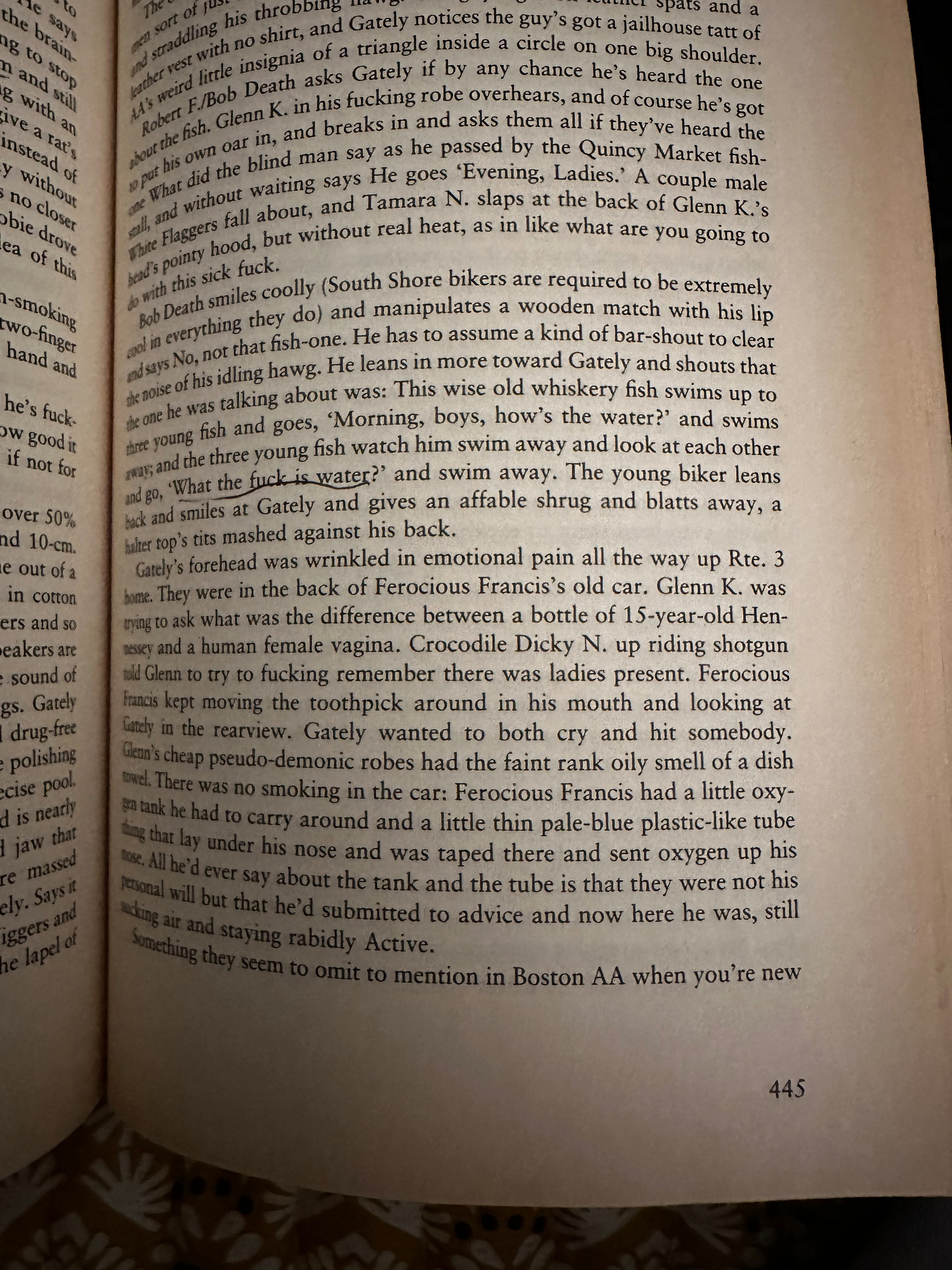
The smell of water
Waterlogged grief is what I feel instead of nostalgia, for the “old” web. Once, we could be impressed by the “mind-boggling effects” of low-res polygonal graphics because we’d seen so little. Now we mock ourselves for having been so innocent, for not knowing we’d soon see too much and be drenched in a flooded dead-end of graphics far more pixel-dense than the ocean-blue skies of 1994-1996. Yet the “open” web and the early days of online forums, every bit as Paleolithic as those PlayStation 1 skeletons and the water-at-arms-length white clouds of Super Mario 64, are revered and placed beyond mockery: “Look at my first days getting online, and marveling at the still-new expanse of the wide-open world-wide web.” Yes and now you’ve charted it all, such that the waterlogged fatigue of having overwatered a walled garden should make us regret having ever felt good about it, the way we chide ourselves for having been impressed by a little light. Do I want to be nostalgic, if it means just idolizing something destined to become evil and enclosed? Or, it was always that way, lusting anxiously for the storm that’d soak it in sad optimization and send it walking through Eden heavy with a rainy hangover?
I can smell the rain coming from my desk—petrified god’s blood, darkening the thawed soil out on the quad with its transformed cloud light. Joseph had left, and I could still see replay the image of his nude body bouncing off the fat tube TV and then across the thin PC monitor in front of me in windshield streaks. A black LCD-faced box, it’s now lit vermillion-hot, to the verge of blushing from remembered analog porn in million-x-speed rapid rewind, and its CD/DVD tray—my main preoccupation with it now, since Facebook is still only an encyclopedia, online video is as blurry as the spools of my brain-VCR, and the semester has just ended and MS Word with it—is open and empty and the only way to spin all this ambience into permanent digital bits, to cross lasers within while a rainbow erects an epitaph for the still-living petrichor dust without, is to float like a balloon into the weather—to test myself.
I’ve condensed my breath into mouth tears that evaporate before they hit the ground; I’m amazed anew at how the anxiety machine before, and now behind, me can’t produce relief, can’t turn itself off unless it does so in error. The wetwork brain of the clouds, without a circuit or register or file system anywhere, has uptime the PC can’t match—endurance, and what is objectivity if not showing up and refusing to depart, being there and being the only person who can say “yes”. It stays hard longer, folds and wrinkles itself into a smoky intelligence, than a hard drive deep in the guts of my Newsfeed-to-be. Someone’s left a leaflet for the Halloween party:
There’s a line drawn in New England
By whose finger, dipped in paint the color of space, Only Lovecraft could tell.
Through wild Massachusetts it runs, colorlessly,
Along the way
Professing new imperial hues—
Green Line—Red Line—
That are only synonyms to the colorblind,
Just horror-story titles
For the effects of atmosphere, like Blood Falls.
So its demon train speeds on
Gobbling up the Mass. line
As if it were regional snow dropped
On anodyne Mars, racing
Through the smells of ocean and old industry.
It, too, is an aging machine,
Born on an ancient planet,
Rusted atop West Lake Bonney.
Gray men, white lines, black woods:
The conductor in his silver suit
Looks like he emerged, glowing,from A virgin mine on the bottom of the world;
The lines, with that color out of space,
Is a Stygian imposter pointing the way
To Antarctica, or Rhode Island, at least.
The engines know neither forward nor backward;
The lines, just our red-green colorblind wishes;
They ferry aliens into the future, taking us
Further beneath the iron sea,
Where the past hasn’t passed
From the lined face of the earth and
There is no line next to the ‘T."“They flew two buildings into the Antarctic sky, made an ‘H’ with no crossbar—made the field goal instead of doinking it off an upright. Their rocket powers sent the firmament a million miles away—and, from 55 yards, it’s good!—flung far from the secret garden base,” she paused: “Knowing me, you’re overcome with my ashy scent and—“ look at her eyes, with their globes aflame as maps of a serpentine tree growing so fast it’s snatching the fire of an angel’s sword two neighborhoods over, and “that igniting feeling, hot pain not yet the burnt pain of recognition, of a prick when a long ago-escaped skyscraper, now miniaturized like a balding follicle, enters your hairy arm to descend to the final place where your illness dwells, well—it’s masked by your cedar-smelling dreams of escape, of your anxiety leaving on the last exit off your body on the needle, while you leaf through thoughts of becoming all mind, all neon, all surface. Those thoughts, though, they’re mere spent lords of cinder, they’re incorrect and…”
They. Them. Themself—that one always seems funny, alive with awkwardness, “that’s not correct,” welp it is my ledger, my elephants. Here be dragons, here be them, here be they the dragons, here be at long last The Multigendered Dragon Themself astride the city in the freshly temperate deep-deep, bottom of the globe southern wilderness.
Halfway across the quad were some posts with masks atop them, like slayed specimens of extinct monsters: Paleontological werewolf, ancient pumpkinhead, fossilized vampire. I’ve got a hard rain-shield raised to the sky, and a soft hand in my deep pocket that I can fling gloveless, with enough exertion, to blow off a motionless windmill almost as good as any huffy breath of fire ever could. The wind is energy, it’s commodified dragon heat, as much a vein dug into the past as a fossil-fuel well. And in this world of hot air, I’m a renewable energy source with a green thumb moistened to steer the course of my blows.
Their orange heads are still green with infection The insect-borne bug from colorless space Whose carriers survived a torching by Space Ghost And now buzz, repeating solemnly “Leave the carrots alone”—
The landscape on the quad is moist with the sound of goodbye—dumpsters greased with what looks like the extinction of computers themselves (get him out of there!), footpaths vacant because the trips were replaced with final digital messages before going completely Inside. A bearded specter of communism walks between the turbine shadows and the hidden manes of the wind-horses harnessed by the spinning machines, handing out pamphlets, the first page of which reads:
“Panic in P-Town! Mob mayor clobbered by slob chef’s video”
I tell the ghost, “I knew the cinematographer, who was also coincidentally the director and the writer. He had me over to unspool some ideas before wrapping them into the improvisation of his capture. He ‘filmed’ it over a video of us fucking, but it’s just a dusty file with a filter on it.”
It asks, “And a file, how do you move it?”
“There’s no files left on this field, the men all have papers—
That’s Karen G droning to me in the clinic, she’s going, keeps failing, keeping trying again, keeps suffering for her art and telling me to ignore the needle’s addition by subtraction, how it adds new honorifics to diminished blood, and want more, none of this to desire is to suffer mantra-ing, keep it out, keep going, keep, keep, keep. Everything I want and everything I need is in here in this little chatty box I like to finger rhythmically, she probably thinks, “What is the best way to implement cloud business solutions,” “What is System 7,” “What is the upkeep of a pool exposed to Minerva-titted rain”—she tortures her eyeballs with the answers to her keyboard gyrations, edicts which had with the ages puffed my room full of the digital dragon’s breath such that I’d run breathless out into the now-yellow rain.
A car rushes past the barely-announced convenience in a nearby Kentucky holler. The Marlins and the Braves are playing on the TV visible from its porch.
“It’s Wohlers with the 3-2 to Johnson. Strike three!”
Why they care is unknown but I pass just in time to fling a scratched ticket into the piles of paper that go everywhere when the game goes final.
Joseph’s coat is finished with a violet collar whose color he generated from a text prompt to an LLM so sycophantic its logo is a squirrel teabagging some acorns. “It’ll look great on you, yes that’s right,” I could imagine that purple being as lickable as a fuzzy computer icon.” Suck it up, computer, finally you have to suck me off, “off” as in a redneck staking his life itself to call someone on a bluff with the threat of GOING OFF, me turning it on is not even my final form.
Here in the on-premises mines within the earth’s Tetons, the machines had jiggled black fleshy soil inside-out looking for rocks sharp enough to someday do some thinking as Nintendo 64 CPUs. Rock heads pensively festooned with red berets: Who else’d even be around in this lonely mountain to dig up future memories of game boxes with rare white clouds on them?
“Cloud-chained infrastructure can deliver best-in-class…”
Dust had poisoned almost everyone, turned even the nice-weather-today clouds wine-dark. Meanwhile, the endless growth of Yahweh’s seed-planting companies had snarled the green meadows, collapsed the greystone chapels within their polygonal castles, and flattened the peoples east of Eden with the cloud-streamed lossless files that stimulated them. “I’m sorry I can’t help with that,” the voices of their talkback war machines would say from script when someone asked them to stop.
What do I have except this door that I can fling back open to the at least still-light outerworld whose roof of azure clouds is the only acceptable non-objective art for reactionary realists, fair weather foes who need starter Rothkos. The reversal made the point too obvious. “I was there in 1996-1997 when the clouds were still white,” was a rallying cry for the Analog Rebels who’d marched on the Tower of Babel the day the clouds had turned, and were still camped there with enough vigor to be told to please for the sake of King David’s reelection stop these protests, you’ll upset the median stranger in a strange land as they’re walking to the polling club.
“1996 and 1997.”
“I know, but what’s so memorable about it other than being an irresponsible kid?”
“The epoch of white clouds. Childhood was a sober intoxication, one that we recognize…Captain Hollywood Project had the giant godhead looking out over the low-res texture mapped mountains and the cottony clouds shadowing them.”
Isaac was a cipher: A real recluse, during the days when being one was synonymous with being a scarce genius. Think Jeff Magnum and how the end of all fresh Neutral Milk Hotel releases in 1998 turned him into an idea, rather than a person, in the eyes of his “fans,” or punishers, who’d sat in hotel rooms conspiratorially shining lasers through plastic discs to scrutinize tales of young-girl communists and create questions about music that even at its inception already felt archival due to the way it’d been scrutinized beyond any leisurely pursuit. You could disappear and just let your work do the work—ironically, drawing more attention to you as a person, and how you’d transcended the mortal grind, gone over the sea to godliness in your lil’ aeroplane.
There’s an arm-tingling breeze whenever listening to these rare standalone albums that loom over their artists’ discographies like inscrutable Towers of Babel about to collapse from attention. They insist upon themselves, flexing without their carboard sleeves, in the CD player tray, while you’re alone with your thoughts and your pre-2007 cellphone, the two of you Plato vs. Aristotle worlds apart in the School of Athens, debating if your distracted conversation partakes in the Forms of those song lyrics you just heard—that smooths out the basement air, shipping its restless dust trails into someone else’s light outside the window, prompting me that I have to know who made this.
“Drop me off by the side of the road…”
We see the art of others as inhuman and mentally pour ichor in their veins because we can’t see any relatable blood or bone beneath the godly armor. We don’t know them, so saying that they’re far away from their tools is easy. But when we turn this romanticizing on our work in the vain and valiant attempt to regard it distantly as if we hadn’t even done it—had never molded it in a brain-y analog haze, but instead watched as God delivered a perfect fucking digital copy from the cloud, severable from the local oddity of our own body-minds—we only St. Peter-ize it thrice before the cock crows and then feel the vibrations of its fundamental earthiness. We wish that we didn’t know we’d written it, that we can’t see that sleazy skeleton beneath its inky inanimate life, wish we could look back at the cities-of-the-plain-piece-of-scratch-paper and not be turned to pillars of salt at the embarrassed memory of how flamingly bad it all once was and still is. We wish we could separate ourselves the artists from our various it-selves the works of art, and we extrapolate our ambition outward like Abraham threatening Isaac with a good time.
But me—I was for the analog world before I was forced to be against it. There’s so much e-waste both in sight and absorbed through the generations into my own watery cloud body that I once couldn’t even finger the warm pink thought of how music could’ve ever been this non-digital, this completely unfuckable-with by computation until I’d learned that the hit Parallel podcast was still pneumatically pushed out and into ears from tapes—magnetic recording, does it work?—that I had to unspool and destroy. Abraham had Isaac, and I have all the tapes in the world to erase, to prove to our Grand Cloud Emperor that I’ve kept their covenant, to make the world computable. The hard drive is getting wet as I toss off the computer debris weighing down my blood, too acidic now from the rainwater going through my mouth into my system.
-
When I first tried playing Octopath Traveler in 2018, I thought its graphics gimmicky and its narrative fractured. But returning to it now, it’s a revelation: A game that does more with sprite graphics than simply be nostalgic for them, and whose bite-sized stories are perfect for the phone age.
-
Non-masterpiece theater
One of the most paralyzing feelings when writing, painting, or anything-ing is the feeling that you have to make a “masterpiece.” Oh let me scratch that off, it’s not the pretttiest picture ever drafted nor the slimiest insult ever hurled. Let’s sit down and really plan this out, maybe storyboard it, or even spin out some Jira tickets that atomize its actions.
It’s infuriating and yet it can feel impossible to fling off—“do I just not care, like not a bit? Do I too need to check my privilege instead of mansplaining with my freeform writing?” That was until I read Manny Farber’s essay on termite art vs. white elephant art.
He skewers in painting in particular the “burnt-out notion of a masterpiece,” with its “obeisance to the canvas edge” that undercuts its nominal radicalism. How free can an artist really be if they’re just consumed with the strict forms of the Old Masters?
This argument reminded me of why I always disagreed with assessments that said that OK Computer by Radiohead or (insert another album here) was the actual “greatest” album and not Sgt. Pepper, the traditional rock-critic pick for that accolades. Silly: those other albums are simply obeying the form of Sgt. Peoper, too tepid to move beyond even its tiny details such as the cross fading of songs into each other and the big, long closing number.
Taking risks makes me nervous, but less so than trying to make everything a smoothed-over “masterpiece” that visibly bears the weight of all its predecessors. Sloppy drawing, sloppy blogging, sloppy living with few “optimizations”—it’s so appealing in an age when anyone can make their own synthetic “masterpiece” for their fellow screen-eye-glazed shutins with a few clicks.
-
Today’s book haul. I’m glad to see Rita Hayworth and the Shawshank Redemption get its own release apart from the 80s collection (Different Seasons, also the source of Stand by Me) that originally housed it. Meanwhile, this Helen DeWitt book has a head-spinning cover.
-
I have a substantial CD collection. But I didn’t think to wrap them in resealable plastic sleeves til I saw the practice of doing so in Japan, where such wrappings keeps the paper obi strip with the case. Also, Japan has a plastic crisis.
-
Substack is not blogging
One of the allures of open-web blogging, for me as a humanities student at its zenith, was its aesthetic novelty. We had straight news drip-dropping in like it were written in classified section code, gems like
The offline world of the 90s and 00s1 was filtered for, if not prestige, then at least a curatorial spirit. Everything from a magazine article to an evening news broadcast was a clear remove from what you’d hack together in your word processor or otherwise by hand.
Blogging bypassed the filters. Oh, to have been old enough to have carved out an omnipundit niche as a guy who wrote sub-Joycean 100-word updates throughout the day on Senate bill proceedings which would’ve given me a reputation as a “policy wonk”!2 The old school blog switched between the forms of diary, travelogue, AP newswire, memoir, and others in a way that felt self-unconscious.
The ad monopolies of Google and Facebook plus the great sucking sound of social media meant peak blogging came quickly, probably somewhere in the early 2010s at the latest. By the time it became somewhat popular again with Substack, Ghost, et al., it’d become something else—something optimized and also platformed, in that it was part of an online economy in which where you publish matters much more than what you publish.
Every newsletter in my inbox would threaten an all-encompassing (and paywalled) tract on “The End of Oil and the Final Reckoning for the West”, “The 900 Best Movies of the Year”, or “Why You’ve Done Everything Wrong Until Now—Here’s How to Come Back”. Every post was now an event, delivered on a schedule to meet subscriber expectations like a weekly (or yearly, if you’re Netflix) drop of a streaming episode—appointment reading!!
Some of these I’ve enjoyed, I’ll admit, but it’s exhausting, especially as someone who’s aspired to blog again and didn’t find the Substack model something I could live with. Substacking requires a level of audience building and more so production value (charts, statistics, enormous back stories and lores) that blogging didn’t. You have to be visibly professional for it to work.
I expect this’ll get even worse (or better, if you’re good at it already) as “AI” tools up the stakes for length (need to pad the post with some machined words so it’s a “deep dive” and not just a “quick take”), extremity of takes (to stand out from the moderate slop), and graphical overload (illustrations aren’t enough now). Ironically, one of the guys who’s most pushed Substacking/nouveau blogging in this direction is a nominal “AI” skeptic: Ed Zitron, who brags about the 5-figure word counts of his epic, “data”-heavy letters and who was recently exposed as a conman, eager to take AI money while melodramatically railing against it.
Anyway, I moved to this site a few years ago because I wanted a space to blog unprofessionally, without the SEO optimizations I’d spent years learning, the goal of becoming a “video podcast” franchise3, or the further aspirations to be a longform historical explainer video guy. Jürgen Geuter (“tante”) wrote a great post late last year on the distinction between creating (now associated with software and AI assistance) and making (doing things in an analog or at least haphazard fashion). This passage in particular really inspired me to run with my sloppy blogging this year:
I think that the focus on creating is just the little capitalist devil sitting on our shoulders telling us to produce more.
I think the most radical act today is to just make something. Especially if you are not good at it or if it’s a bit of a struggle. Draw if you’re not good at it. Play the piano even though you’re not great. Make something just for the fun of being in this world, touching it, being in it. Becoming you. Let this radicalize you a bit.
Fuck creation. Love making.
Love making—that’s the goal.
-
today’s offline world is filtered for the opposite, i.e., spontaneity in opposition to the totalizing professionalism that’s overtaken the online domain. ↩︎
-
people like Matt Yglesias, Noah Smith, and Ezra Klein are famous purely because they were elder millennials who capitalized on the incredible low bar for achieving fame in the golden era of blogging, when a string of sloppy posts was enough to put you on the cutting edge ↩︎
-
though I do have an audio-only podcast! ↩︎
-
-
Seven Nation Army
Alabama lost the Rose Bowl to Indiana today, 38-3. Between the whistles throughout the game, the Million Dollar Band played the first few bars of “Seven Nation Army,” a song that has joined the likes of “Rocky Top” and other school fight songs as a staple of football 1 culture. It’s the enduring legacy of The White Stripes, something that’d have been impossible to predict when that band broke through in 2002 with the Lego-inspired music video for its song, “Fell In Love With A Girl.”
From 2001-2002, the music press (remember magazines and newspapers?) in America and the U.K. couldn’t go a beat without talking about the garage rock revival led by the Stripes as well as The Strokes, The Vines, and The Hives (a big couple of years for the definite article of the English language). The Strokes' debut Is This It was the catalyst for the movement but The White Stripes were the band that ultimately received the most sustained attention—I remember sitting in a computer lab and reading an early review of their 2003 album Elephant (which leads off with “Seven Nation Army”) that compared it to classic 1960s releases from The Rolling Stones and Jimi Hendrix, as something you wish you could hear for the first time again, unburdened by knowing what happens in the end.
My first listen ended up being in a barn, on a Sony Discman. The bass notes2 that open “Seven Nation Army” are arresting not just for their hummability but because until then, the Stripes' second-biggest gimmick (after the lie that they were siblings, rather than a divorced couple) was that they didn’t do bass lines. Reading what felt like 1,000 profiles of the bands in the literal pages of Spin, Rolling Stone, and Blender made the Stripes come across like musical puritans who, like their compatriots in the garage rock revival, were stripping away the artifice and bloat from pop music:
- Everything was about the number “3” (seen even in the stylized letters of the Elephant album font, which rendered the “e"s in that word as “3"s instead), including the magical three components of voice, guitar, and drums (so no bass; but piano, often used in their songs, didn’t count?).
- Jack tried so hard to seem like an old soul, acting as if his favorite artists were old bluesmen despite the fact that a listen to the band’s records would reveal that they spent a lot more time listening to, say, The Pretenders3 than to Robert Johnson.
- Their apparent hatred of fame and the mainstream meant that they often rushed through their recordings, to their detriment. Later records, including Elephant and Get Behind Me Satan, seemed uneven and unfinished compared to their gloriously lo-fi trilogy of pre-fame albums, because (unlike those constrained records) they were trying to convey a ton of styles with too limited a tool set.
“Fell In Love With A Girl,” its Pretenders lift notwithstanding, seemed like it’d always be their signature song, until “Seven Nation Army” resonated through the barns and car radios of guys driving home after their driving test the same day as its release on April 1, 20034. The latter song, by becoming so thoroughly absorbed into major corporate sporting events, became the opposite of the “wow this sounds like a lost 60s garage classic!” initial reaction that I and so many had to “Fell In Love With A Girl.” It became the sound of ubiquity, even of Muzak. But by being played alongside ancient chestnuts like “The Eyes of Texas”, it perhaps achieved the band’s goal of making classic Americana, of making something new that everyone instantly recognized as something bound to become old, so old it’d become anonymous and detached from its makers.
-
I picked the dandelions in a cemetery, two years ago. Now the cemetery is gone.
Thomas Pynchon, The Crying of Lot 49
-
Many blogs read as if the user sees him- or herself at the center of the world, with his or her posited audience hanging on every action the blogger takes—almost as if the blogger was a different order of human being from the blog’s readers.
David Golumbia, The Cultural Logic of Computation
-
The 20/20ness of the Nintendo Switch's success
Nintendo announced the Switch 2 today. The conventional wisdom is that it’s “boring,” but in a good way—finally, Nintendo has settled down into an almost Sony-esque cadence of numbering its consoles in sequence. The Verge’s Andrew Webster summed up this view:
Really, the form factor of the Switch didn’t need changing. It’s clear consumers loved it; Nintendo has sold more than 146 million of them, as the Switch inches closer to toppling the DS as the company’s bestselling piece of hardware. It’s flexible in a way that made sense for a large group of people, and it helped spearhead a renewed interest in portable gaming, one that is now taking the PC world by storm. Even Microsoft and Sony are tentatively getting into the space. And by merging its portable and console development teams, Nintendo was able to focus on a single device and greatly improve the cadence of new releases. Over its eight years of existence, the Switch had surprisingly few lulls between major new games.
The Switch will outsell the DS and may yet dethrone the PlayStation 2, despite the latter having the enormous advantage of having been the first and only DVD player that many people ever owned, right at the peak of the physical media era (2005, the year before the PlayStation 3 and Blu-ray Disc tech came out, was the top year for DVD sales). A portable console that can output in HD to your TV seems blasé now, a surefire winner. But it wasn’t obvious at all in 2016.
Surviving the smartphone gaming era
In the run-up to the Switch’s unveiling that fall, there was a lot of confused talk about how Nintendo was building a cartridge-based system, in an era in which its two rivals (the PlayStation 4 and the Xbox One) were all-in-one media centers with their Blu-ray drives. It seemed like a recipe for doom, especially on the heels of how badly the Wii U had sold. Nintendo hadn’t sold a cart-based home system since the Nintendo 64, which, while fondly remembered by some millennials today, was a major failure in that it permanently ceded a huge segment of the gaming market to Sony, and mostly on account of its usage of expensive, low-capacity carts at a time when cheap, high-capacity CDs were becoming the norm.1
The 3DS—the DS’s lookalike successor—was the only thing keeping Nintendo solvent during the lean 2011-2017 era, when Wii-mania had ended and almost no one seemed interested in its successor. Even its success was qualified—though it sold over 75 million units, that was only about half of the DS’s haul. Moreover, the idea of a dedicated handheld with a ton of buttons seemed antiquated in the era of smartphone gaming.
The early and mid 2010s were the “smartphone gaming” era, when gaming on your phone felt novel and limitless in its possibilities. I remember seeing a bar graph on Business Insider about how Angry Birds had already “outsold” the entire Super Mario series. The simplicity of touch controls plus the ability to add overlay controls onto a touchscreen (i.e., virtual buttons) seemed like the “end of history” for mobile gaming.
In a 2013 post cheekily titled Nintendo in Motion2, John Gruber said:
Nintendo is doing poorly because they seem incapable of producing best-of-breed hardware, both in console and handheld. The world has changed in the last five years, and hundreds of millions of people now carry powerful, well-made, touchscreen computers with them everywhere they go. Nintendo should expand to start making games optimized for these devices—in the short term as [an] opportunity to sell more games, in the long term as a hedge for the possibility that the company will no longer be able to compete at all in hardware.
He was responding to a Lukas Mathis post that had said “Mac analysts” (a catch-all term for Apple-focused bloggers like Gruber) had an obsession with Nintendo that resembled the obsession Microsoft analysts once had with Apple (thinking it should just stop making hardware, etc.)
Nowadays, Mac analysts have a similar obsession with Nintendo. The logic goes a bit like this: Nintendo is doing poorly because Apple and Samsung own the market for portable devices. If only Nintendo stopped making hardware and published their games for iOS instead, surely, it would do much better.
Mac users should understand why this argument is flawed. Fantastic games like Super Mario 3D Land can only exist because Nintendo makes both the hardware and the software. That game simply could not exist on an iPhone. Nintendo makes its own hardware because that allows it to make better, more interesting, unique games.
But there’s an additional problem with this argument: the premise is completely wrong. Nintendo is actually not doing poorly in the portable market. iPhones have not destroyed the market for portable gaming devices. The 3DS is, in fact, doing very well.
Gruber turned out to be completely wrong whereas Mathis was completely right. In fact, the success of the 3DS was a turning point in gaming history, although it wasn’t recognized at the time and maybe not even now.
How the 3DS changed the game
The 3DS was widely perceived as just a DS with stereoscopic (glasses-free) 3D technology and maybe a little more horsepower. In reality, it was ridiculously capable for a handheld gaming device:
- It was in practice almost as powerful as a PlayStation 2, with the ability to run complex games such as Dragon Quest VII, Super Smash Bros. For 3DS, Metal Gear Solid 3: Snake Eater, and Xenoblade Chronicles3. The “3D” in its name wasn’t just about the stereoscopic effect, which was largely gimmicky—it was also about the console’s plethora of fully 3D titles, games that the original DS couldn’t possibly have run.
- It had an analog stick (and a camera stick on later models) and tons of buttons, plus two cameras.
- Also, it was compatible with the entire DS library.
Nintendo priced it very high, seeming to realize it had built a colossus. But it took a while for people to catch on. The price was quickly cut and it was only in 2013 that the release schedule finally started humming with titles such as The Legend of Zelda: A Link Between Worlds and Luigi’s Mansion 2. As Mathis noted, these types of games, with their clever use of the dual screens and complex controls, were simply impossible on the featureless face of an iPhone.
Rather than an antique avatar of a bygone dedicated handheld age, the 3DS was the herald of a new era in mobile gaming, when tiny bespoke hardware could run titles that phones and tablets couldn’t touch and that rivaled home consoles and PCs in their complexity.
Even now, the 3DS’s library is astonishing in its depth, with everything from addictive puzzle games to mature-themed visual novels. The only Nintendo console with a similar depth and breadth of titles is the Switch, which I think is better thought of as the successor to the 3DS than the Wii U.
The iPhone moment for console gaming
With its ability to read Amiibo, its use of ROM cartridges and microSD cards, its ARM processor, its dual sticks, and its big screen, the Switch is like a slightly tweaked New 3DS4. The original Switch instantly made other gaming options, whether less (phones, tablets) or more (PCs, home consoles) complicated seem instantly outmoded, in the way that the original iPhone did for flip and feature phones in 2007. Gruber sees this:
That it’s just a bigger faster Switch is proof of the genius of the Switch form factor, which has now been widely copied across the industry. The Switch is to handheld + dockable console gaming what the iPhone is to phones.
Its variety of buttons and sensors made smartphone gaming seem too simple; its instantaneousness and portability made hulking PCs and consoles seem like heavy, slow, power-hungry dinosaurs. The only traces of the Wii U were (sort of) the tablet design from that console’s controller, but again, I think the form factor of the 3DS is a closer analog.
It shocked me at the time, in a way I don’t think any of its successors may ever do. Its success is maybe the best example I can think of the “hindsight is 20/20” cliché, but to really see why it was set up for success from day one, you have to see the 3DS for what it was—a signpost to the future rather than the past, maybe even “Nintendo’s iPod,” in how it led to “Nintendo’s iPhone” (the Switch).
-
The Switch represented Nintendo’s final divorce from optical disc technology, which had bedeviled it for almost 30 years at that point. The Super Nintendo Entertainment System was supposed to have had a CD-ROM attachment made by Sony, but the parties fell through and it became the PlayStation 1; the Nintendo 64 lost big to the PS1 because of how much easier CDs were to develop for; the GameCube, Wii, and Wii U all ran on proprietary optical disc formats designed to avoid paying royalties to Sony et al., but which came with the drawback of lower capacity than either generic DVD or Blu-ray. Now, optical discs are far too slow to actually run games from (PS4/5 and Xbox games are simply copied from the disc to the internal drive) and they put a major constraint on form factor. Neither is true of ROM carts, which remain super-fast, can be really tiny, and now can hold tons of data. ↩︎
-
A reference to Research In Motion, the old name of BlackBerry. ↩︎
-
This only ran on the New 3DS, which had extra processing power and more inputs (two more shoulder buttons and a second analog stick) ↩︎
-
In addition to the more powerful ARM processor, extra buttons, and second stick, the New 3DS had a built-in Amiibo reader and used microSD cards rather than full-size ones like the original 3DS. ↩︎
-
2006 music reviews rocked:
The Web site … shows a NYC apartment populated by, among other things, a sketchy rumpled bed (ew), bright red oversized American Apparel underwear (double eww), a Serge Gainsbourg record (triple ewww), and (pre-emptive quadruple ewww) The Village Voice.